
Must-Have vs. Nice-to-Have RV Features

Learn how to separate everyday needs from appealing extras so you can choose an RV that fits your trips and your budget.
Walk through a few RVs, and your wish list can grow quickly.
An outdoor kitchen. A bigger refrigerator. Theater seating. A second bathroom. More storage. That beautiful kitchen island you weren’t thinking about until you stepped inside.
There is nothing wrong with wanting those features. Part of shopping is discovering what is available.
The challenge is knowing which ones will make your trips better—and which ones simply made a good first impression.
Before comparing everything an RV offers, decide what you need it to do.
Start with an ordinary camping trip
Picture the kind of trip you expect to take most often.
Who is coming? How long will you stay? Where will you camp? What will you bring? How much time will you spend inside?
A family camping on weekends may have different priorities from a couple taking monthlong road trips. Someone who cooks most meals indoors may value kitchen space differently from someone who prefers cooking outside.
As a father of five, I know a layout can look spacious when you walk through it alone and feel very different once everyone needs somewhere to sleep, eat, and put their belongings.
Build your list around the trips you can realistically take.
Separate requirements, must-haves, and extras
It helps to use three categories instead of putting everything on one wish list.
| Category | What it means | Examples |
|---|---|---|
| Basic requirements | Conditions the RV must meet before you seriously consider it. | Verified vehicle compatibility, suitable travel seating, workable storage arrangements, and a comfortable total budget. |
| Must-have features | Features your regular trips would be difficult or impractical without. | Dedicated beds, an accessible bathroom layout, or space for equipment you bring every time. |
| Nice-to-have features | Features you would enjoy but could reasonably compromise on. | A fireplace, upgraded finishes, or a particular entertainment setup. |
The same feature can belong in different categories for different buyers.
A separate bedroom might be essential for someone who needs to sleep while others are awake. Another buyer may be comfortable with a more open layout.
Your list should reflect your household’s needs, not someone else’s idea of the perfect RV.
What makes something a must-have?
A must-have usually solves a recurring problem.
Try finishing this sentence:
“We need this because, on most trips, ______.”
For example:
- “We need dedicated beds because we don’t want to convert the dining area every morning and evening.”
- “We need usable kitchen counter space because we prepare most meals inside.”
- “We need a bathroom we can comfortably move around in because tight spaces are difficult for us.”
- “We need storage for our outdoor gear because it comes with us on every trip.”
The explanation matters more than the feature name.
“We need a bunkhouse” is a starting point. “We need three usable sleeping spaces for the children without losing the dining table” tells you much more about what to look for.
You may discover that more than one layout can meet the same need.
A nice-to-have can still be valuable
Calling something optional does not mean it is a waste of money.
An outdoor kitchen might become your favorite part of camping. Comfortable seating could make rainy evenings much more enjoyable. A finish you love can help the RV feel like your own space.
The question is what you would give up to get it.
Would you accept a higher purchase price? Less storage? A different sleeping arrangement? More equipment to care for?
An extra earns its place when its value to you is worth the compromise.
You do not have to justify every preference as a necessity. It is perfectly reasonable to say, “We would enjoy this, and it fits our budget.”
Look for the need behind the feature
Sometimes buyers become attached to a particular feature before identifying what they want it to accomplish.
Consider these examples:
| Feature on your wish list | The underlying need to explore |
|---|---|
| Kitchen island | Enough usable space to prepare meals. |
| Bunkhouse | Practical sleeping arrangements and some separation for the children. |
| Large refrigerator | Food storage that fits your group and shopping routine. |
| Second bathroom | Less waiting and easier nighttime access. |
| Large television | A comfortable place to watch movies together. |
| Outdoor kitchen | A convenient way to prepare and serve meals outside. |
| Desk | A usable place to work with suitable seating and room for your equipment. |
An island is one way to create preparation space. A different kitchen layout may work just as well for you.
A dedicated desk may be important for frequent work. For occasional emails, another surface might be sufficient.
Ask yourself:
“Do I need this exact feature, or do I need the problem it solves to be addressed?”
That question can keep you open to options you might otherwise overlook.
Give everyday usability more attention
Some of the most useful details are easy to miss during an exciting walkthrough.
Where will everyone put their shoes?
Can you reach the cabinets comfortably?
Is there somewhere to set a drink beside the seating?
Where will wet jackets go?
Can someone get out of bed without disturbing another person?
Is there a convenient place for the trash can?
These details may not be the headline features, but you will interact with them repeatedly.
During a walkthrough, imagine using the RV rather than simply looking at it. Sit down, move through the rooms, and ask for a demonstration of anything you would need to operate or rearrange.
A feature should work for you in practice, not just look useful on a floorplan.
Think carefully about occasional guests
It is natural to imagine bringing children, grandchildren, friends, or extended family.
Those trips can be wonderful. But consider how often they are likely to happen.
If guests will join you regularly, dedicated space may deserve a place on your must-have list.
If they might come once a year, ask whether you are comfortable designing every trip around that possibility.
There is no single right answer. You may happily give up some living space to make room for family. Just make that choice deliberately.
Choose for your usual travelers, then decide how you want to accommodate occasional guests.
Start with three priorities
Try choosing your three most important features before your next walkthrough.
This is a way to focus the conversation. It does not mean ignoring a fourth genuine need.
Your initial list might be:
- Dedicated sleeping spaces for the children.
- A bathroom that feels comfortable to use.
- Practical storage for the gear we bring regularly.
Or:
- A bed both of us can easily access.
- Comfortable seating for evenings inside.
- A kitchen that supports the way we cook.
Keep your basic requirements—such as compatibility and budget—separate. They still need to be satisfied regardless of how many preferred features an RV offers.
Then create a second list of extras you would enjoy.
That gives you a consistent reference when one model has the better kitchen and another has the better bedroom.
Ask what each feature costs you
Price is one consideration. Space, convenience, and flexibility matter too.
When something catches your attention, ask:
- How often would we use it?
- What would we do without it?
- What space or feature would we give up to have it?
- Does it change our budget enough to affect our travel plans?
- Does it add setup, cleaning, or maintenance we are comfortable with?
You may decide the feature is absolutely worth having.
You may also realize that you liked the idea more than you would use it.
Both are useful discoveries before you buy.
Don’t let the number of features decide
An RV with more items checked off is not automatically the better fit.
One model might include an outdoor kitchen, fireplace, upgraded television, and impressive lighting—but miss the sleeping arrangement you actually need.
Another might be simpler and meet your daily needs comfortably.
Several appealing extras do not make an essential compromise disappear.
When you find yourself making excuses for a missing must-have, revisit why it was on your list. Perhaps your priorities have changed after seeing alternatives. Or perhaps a beautiful interior is distracting you from a problem you will face on every trip.
Give yourself time to tell the difference.
Bring a short list to every walkthrough
Use a note on your phone or a simple worksheet:
Our usual trip:
Where we go, how long we stay, and who comes along.
Our basic requirements:
What must be verified before this RV stays on the shortlist.
Our must-have features:
The features we expect to rely on regularly.
Our nice-to-have features:
The extras we would enjoy if the overall fit and budget work.
Compromises we are willing to make:
Where we have flexibility.
After each walkthrough, record what worked, what didn’t, and what you still need to confirm.
That makes comparisons easier once the interiors begin blending together in your memory.
Choose features that support your camping life
The goal is to find an RV you can comfortably use, afford, and enjoy.
Sometimes that means choosing the model with the additional feature. Sometimes it means keeping things simpler.
I would rather help someone understand those choices than encourage them to buy more equipment just because it is available.
The right features are the ones that make your trips work better for you.
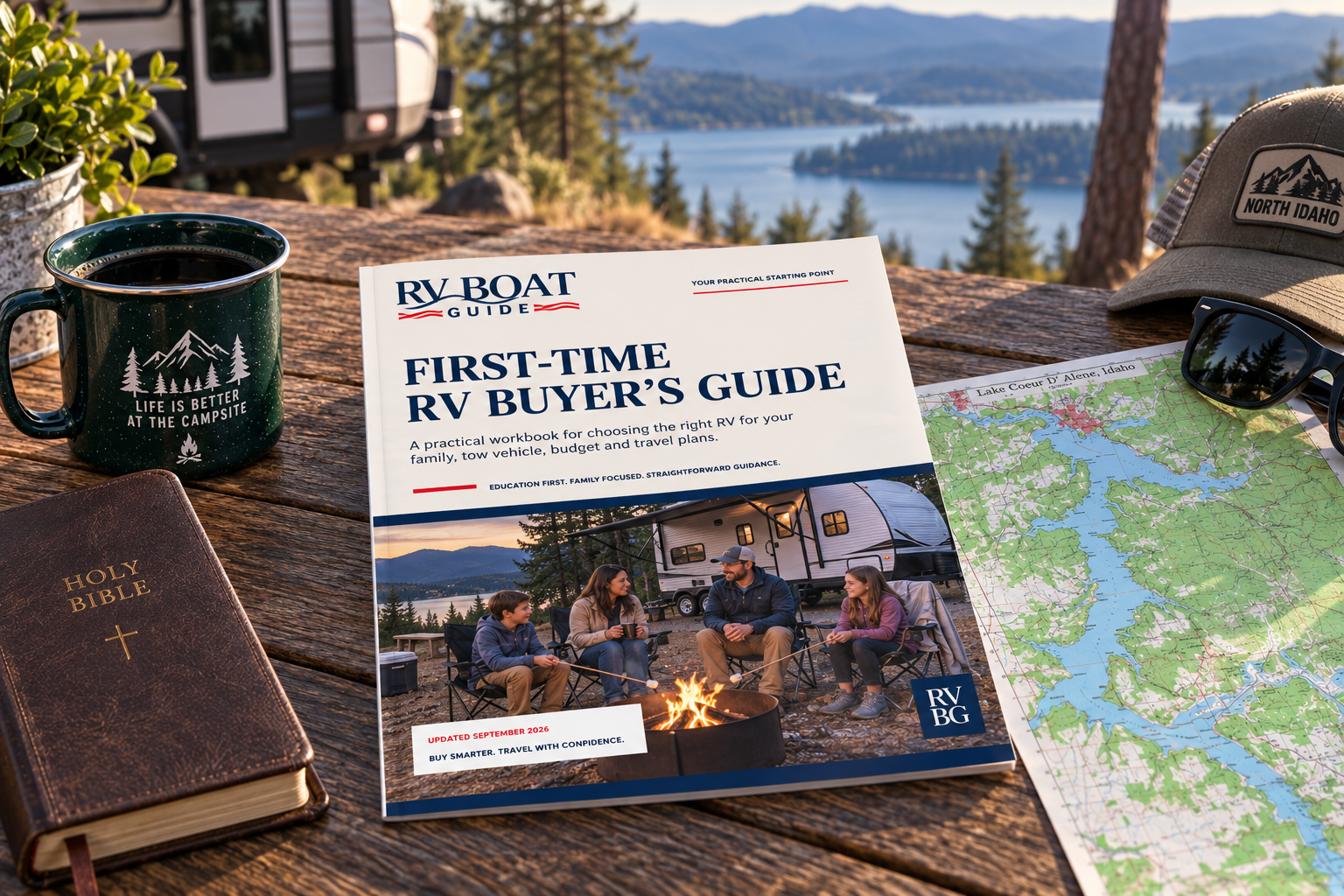
Get the free First-Time RV Buyer’s Guide
Sorting your must-haves from your nice-to-haves is a starting point. The First-Time RV Buyer’s Guide helps you turn those priorities into a practical plan for comparing RVs.
Inside, you’ll find explanations of RV types, worksheets for your travel plans and budget, a walkthrough scorecard, and questions to help you prepare for delivery. There are also first-time buyer FAQs and a plain-English glossary.
Use the form below to request your free digital copy. Keep it with you as you organize your priorities, tour RVs, and build your shortlist.
Want to talk through your options?
I’m Si, founder of RV Boat Guide and an RV & Boat Outfitter. I help RV and boat buyers throughout the Pacific Northwest and can also help connect buyers elsewhere with a trusted outfitter in their area.
If you are trying to decide which features matter most—or comparing RVs that offer different compromises—I’d welcome the opportunity to help.
Message me using the form below. Tell me who will be traveling with you, how you hope to use your RV, and which features you are having trouble deciding on.
You do not need to have a model picked out to start the conversation.