RV Financing Basics

Understand loan terms, compare offers, and build a budget that leaves room to enjoy your RV.
You find an RV that feels right.
The sleeping arrangements work. There is room for your gear. You can already picture your first campsite.
Then the conversation turns to financing.
“How much would you like your monthly payment to be?”
That is a reasonable question—but it is only part of the picture.
The purchase price, down payment, interest rate, loan length, and optional products can all affect what you pay.
Before deciding whether a payment works, understand the full purchase behind it.
Start with your budget before the lender’s approval
A loan approval tells you what a lender is willing to offer under its criteria.
Your comfortable budget is a separate decision.
Think about what you can spend while continuing to cover household expenses, save, handle unexpected costs, and actually take trips.
As a father of five, I understand that the RV payment is only one part of a family’s budget. There still needs to be room for groceries, activities, repairs, and everything else that happens between camping weekends.
Choose a budget that supports the way you want to live and travel.
Learn the terms you will see
You do not need to become a financing expert, but these terms will help you follow the conversation.
| Term | What it means |
|---|---|
| Down payment | Money you pay upfront toward the purchase. |
| Amount financed | The amount of credit provided, as shown in the loan disclosures. Review what is included. |
| Interest rate | The rate charged for borrowing the money. |
| APR | Annual percentage rate: an annualized measure of borrowing cost that includes interest and certain fees. |
| Loan term | The time scheduled to repay the loan, usually expressed in months. |
| Finance charge | The disclosed dollar cost of credit, including interest and applicable charges. |
| Total of payments | The total of the scheduled loan payments if you pay according to the agreement. |
| Negative equity | When the amount you owe exceeds what the RV is worth. |
The Consumer Financial Protection Bureau explains these concepts in its loan terminology resource. Its examples focus on auto loans; confirm the terms and disclosures that apply to your specific RV financing.
APR helps you compare borrowing costs, but you still need to compare the amount financed and the loan term.
Get the complete purchase price first
Ask for an itemized out-the-door quote.
It should make the selling price, applicable taxes and fees, added equipment, and optional products easy to identify.
Then ask how the down payment and any trade-in affect the amount you would finance.
For example:
| Purchase detail | Illustrative amount |
|---|---|
| RV selling price | $50,000 |
| Applicable taxes and fees | $4,000 |
| Equipment you choose to add | $1,000 |
| Total purchase amount | $55,000 |
| Cash down payment | −$10,000 |
| Amount to finance in this simplified example | $45,000 |
This example assumes no trade-in, prior loan balance, or separate financing charges.
The RV’s advertised price and the amount you borrow may be different. Make sure you understand why.
A lower payment can mean a higher total cost
Extending a loan spreads repayment over more months.
For the same amount borrowed and interest rate, that lowers the monthly payment but increases the interest paid if you follow the full schedule.
Consider this hypothetical comparison:
| Loan detail | 10-year loan | 15-year loan |
|---|---|---|
| Amount borrowed | $50,000 | $50,000 |
| Fixed annual interest rate | 8% | 8% |
| Number of monthly payments | 120 | 180 |
| Approximate monthly payment | $607 | $478 |
| Approximate total loan payments | $72,797 | $86,009 |
| Approximate total interest | $22,797 | $36,009 |
Illustration only, not a current rate quote or financing offer. Calculations assume monthly amortization, no fees, and every payment made as scheduled. Totals use unrounded payments.
The longer loan reduces the payment by about $129 per month, but adds approximately $13,212 in interest.
You may have reasons for preferring a particular repayment schedule. The important thing is understanding the cost of that choice.
Ask to see both the monthly payment and the total of payments.
Compare offers using the same assumptions
It is difficult to compare two proposals when one includes a larger down payment, a longer term, or additional products.
Ask each provider to show:
- The same purchase amount.
- The same down payment.
- The amount financed.
- APR and interest rate.
- Loan term.
- Monthly payment.
- Finance charge and total of payments.
- Any fees or conditions.
The CFPB recommends comparing the loan amount, APR, term, and overall cost rather than focusing only on payment. How to compare loan offers
You can explore dealer-arranged financing and financing through a bank or credit union that offers RV loans. Availability and application processes differ.
For example, some RV lending programs work through participating dealerships, while others offer a preapproval process. These are lender examples, not recommendations. Bank of America RV financing information, U.S. Bank RV preapproval information
Understand what affects your offer
Do not assume an advertised rate is the rate you will receive.
RV financing terms can depend on factors such as credit history, amount financed, loan length, down payment, and the RV’s model year and value relative to the loan.
Ask whether an estimate is preliminary and what conditions remain before final approval. Also ask when an offer expires and whether the specific RV qualifies. U.S. Bank RV financing disclosures
A useful question is:
“What would need to change for this rate, payment, or down payment to change?”
That helps you understand which parts of the proposal are settled.
Think about how long you expect to own the RV
Your first RV may teach you a great deal about how you like to travel.
You might keep it for many years. You might also discover that a different layout or size would suit you better.
Ask yourself:
“If we wanted to sell or trade this RV in a few years, what might we still owe?”
Negative equity can make that decision harder. For example, if your loan payoff is $42,000 and an accepted trade offer is $35,000, there is a $7,000 difference to address.
If that difference is included in another loan, it becomes part of the new borrowing. It does not disappear.
Longer repayment schedules can increase exposure to negative equity because the balance may fall slowly relative to the vehicle’s value. CFPB explanation of loan length and negative equity
Ask for an amortization schedule showing how the balance is expected to decline. Treat future resale values as uncertain.
Review optional products separately
You may be offered a service contract, GAP product, protection package, or other optional purchase.
Ask for each item’s:
- Cash price.
- Coverage and exclusions.
- Duration.
- Deductible, if any.
- Cancellation and refund terms.
- Effect on the amount financed.
A product may have value for your circumstances. Give yourself time to understand it.
If its price is added to an interest-bearing loan, you will generally pay interest on that amount too. The CFPB highlights how financed add-ons increase borrowing costs. CFPB loan-shopping guidance
Ask, “What does this cost in total?” as well as, “What does this add to the payment?”
Ask about paying the loan off early
If you hope to make extra payments, ask how the loan handles them.
Questions include:
- Is there a prepayment penalty?
- How is interest calculated?
- How do I direct an extra payment toward principal?
- Does paying ahead change the next due date?
- How do I request an accurate payoff amount?
Get the answers from the agreement and lender instructions. Do not assume every loan works the same way. CFPB guidance on prepayment terms
Also avoid choosing a loan that only feels workable if you can refinance later. Evaluate whether the original terms fit your budget.
Leave room for ownership
Before deciding on a payment, gather estimates for the other expenses that apply to your plans.
These may include:
- Insurance.
- Storage.
- Registration and applicable recurring taxes.
- Maintenance and repairs.
- Tires and batteries.
- Fuel.
- Campground fees.
- Required towing or setup equipment.
Some expenses arrive monthly. Others arrive seasonally or unexpectedly.
Get an insurance quote for the specific RV and intended use before signing. Ask about the coverage the lender requires and the protection you want for your circumstances.
A comfortable payment should leave room to use and care for the RV.
Take time with the final paperwork
Before signing, compare the final documents with the offer you accepted.
Confirm the RV, purchase price, down payment, trade figures, amount financed, APR, term, optional products, and payment schedule.
If something changed, ask for an explanation before proceeding.
You should be able to answer three questions clearly:
What am I buying?
What am I borrowing?
What will repayment cost under this agreement?
As an RV & Boat Outfitter, I want buyers to understand those answers. Financing should be a considered part of the purchase, with enough room left in the budget to enjoy the trips ahead.
This article provides general education, not individualized financial advice. Confirm your terms with the lender and seek qualified advice for questions specific to your finances.
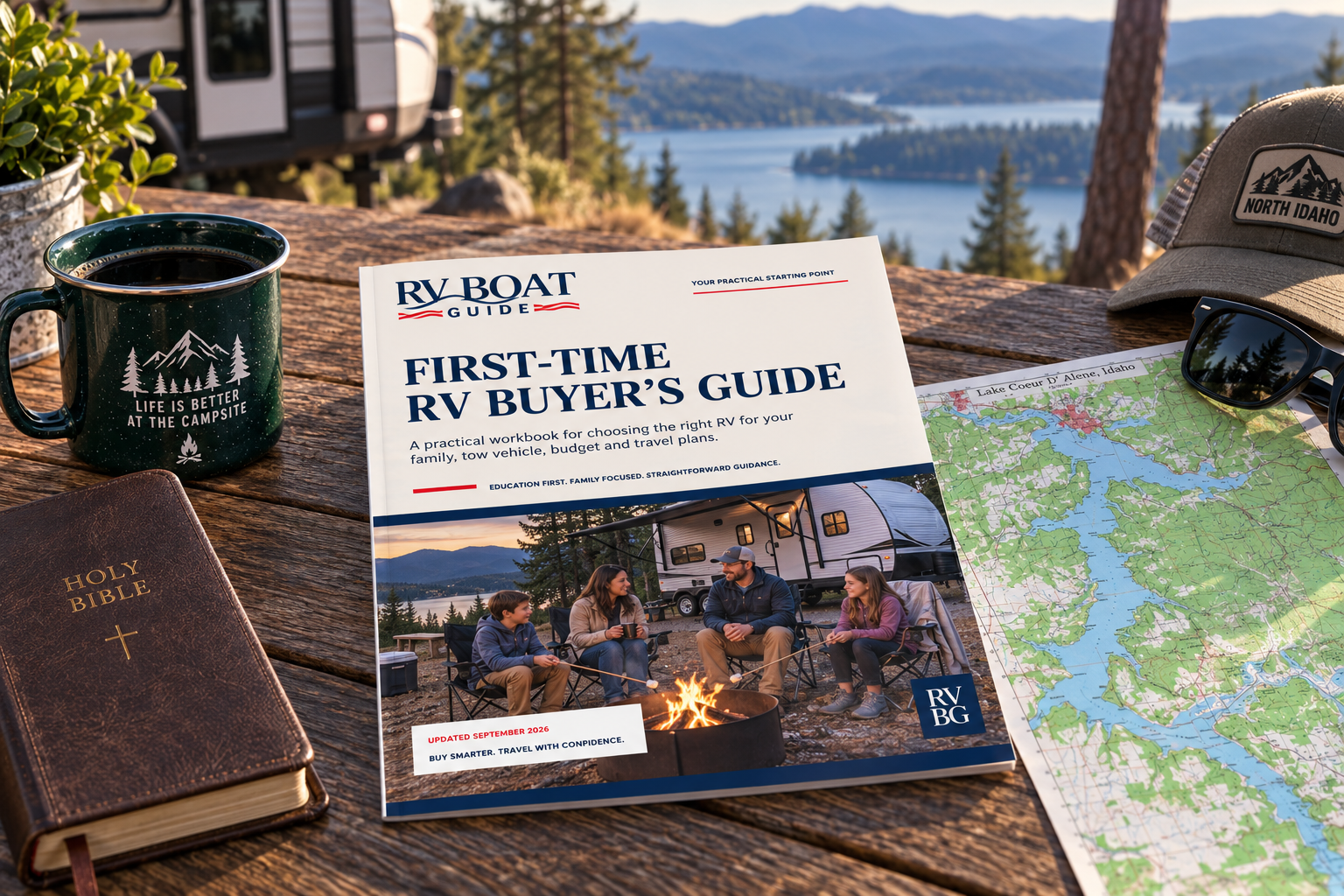
Get the free First-Time RV Buyer’s Guide
Understanding financing is a starting point. The First-Time RV Buyer’s Guide helps you connect your budget, travel plans, and priorities to a practical RV shopping process.
Inside, you’ll find explanations of RV types, worksheets for your travel plans and budget, a walkthrough scorecard, and questions to help you prepare for delivery. There are also first-time buyer FAQs and a plain-English glossary.
Use the form below to request your free digital copy. Keep it with you as you estimate ownership costs, compare RVs, review purchase proposals, and build your shortlist.
Want to talk through your options?
I’m Si, founder of RV Boat Guide and an RV & Boat Outfitter. I help RV and boat buyers throughout the Pacific Northwest and can also help connect buyers elsewhere with a trusted outfitter in their area.
If you are beginning your search or comparing RVs at different price points, I’d welcome the opportunity to help you understand the options and prepare useful questions for the financing conversation.
Message me using the form below. Tell me who will be traveling with you, how you hope to use your RV, and what purchase range feels comfortable. Please keep sensitive financial information out of the message.
You do not need to have a model picked out to start the conversation.