
Travel Trailer vs. Fifth Wheel: Which Fits Your Camping Life?
Compare travel trailers and fifth wheels, from tow-vehicle requirements and floorplans to storage, campsite fit, and total cost. Find what suits your camping life.

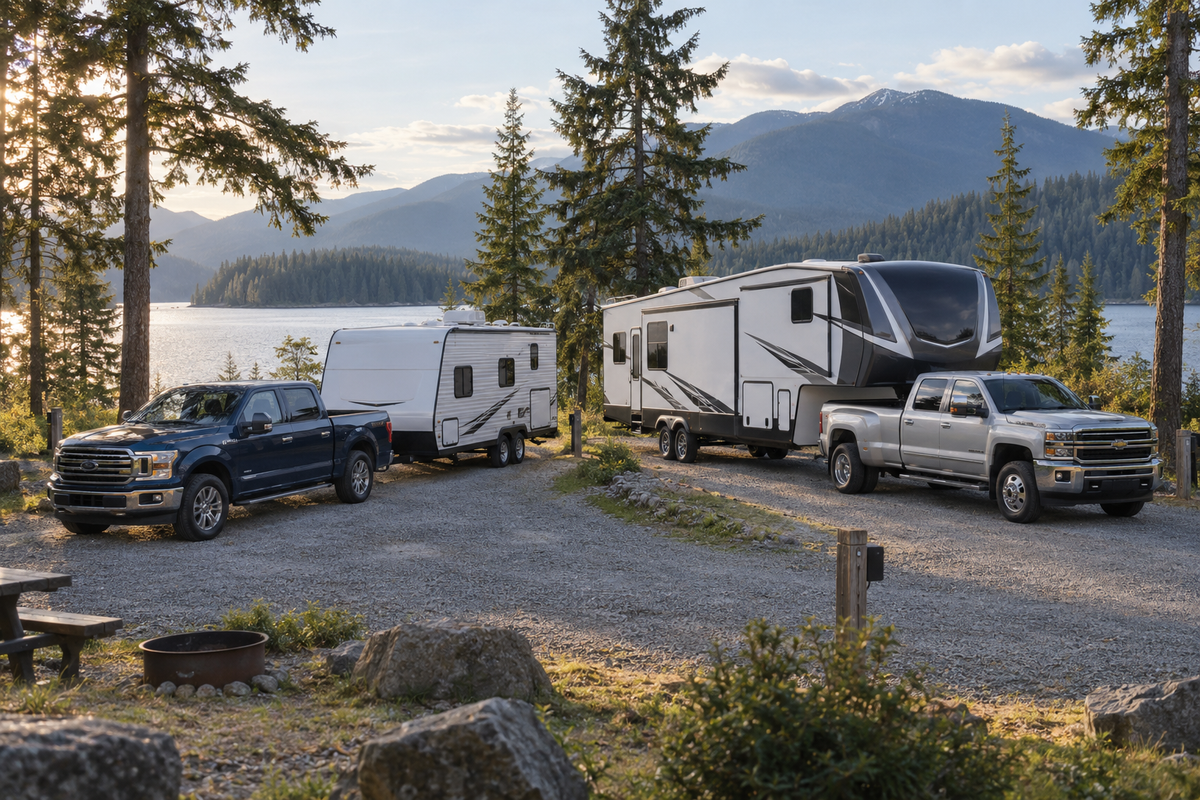
Compare the differences in towing, living space, setup, storage, and cost before choosing your next RV.
You walk into a travel trailer and can picture your family spending weekends at the lake.
Then you step inside a fifth wheel. The tall ceilings, separate bedroom, and large storage compartments get your attention.
Now you’re wondering: should we go bigger? Would the travel trailer be easier to manage? Will our truck work with either one?
Both can make excellent camping companions. The right choice depends on how you travel, what you need to bring, and the vehicle that will tow it.
Before choosing a favorite floorplan, think about the entire setup; from your driveway to your campsite.
What’s the basic difference?
A travel trailer connects to a hitch at the rear of the tow vehicle.
A fifth wheel connects to a hitch mounted in a pickup’s bed. Its raised front section extends over the bed, creating the stepped interior layout commonly associated with this category. Go RVing’s fifth-wheel overview.
That connection is the defining difference. It influences the vehicle you need, how the combination handles, and how much truck-bed space remains available.
| Consideration | Travel trailer | Fifth wheel |
|---|---|---|
| Hitch location | Behind the tow vehicle | In the pickup bed |
| Tow vehicle | A properly rated and equipped vehicle; some models can work with SUVs or vans | Typically a properly rated and equipped pickup |
| Interior layout | Often one main floor level | Commonly includes steps to a raised area |
| Size choices | Includes many compact options as well as larger layouts | Often emphasizes larger living spaces, though shorter models exist |
| Truck-bed use | Hitch leaves the bed available, within load limits | Hitch and turning clearance occupy part of the bed |
| Purchase budget | Often offers a lower entry price | Often involves a higher trailer and truck budget |
These are general tendencies. Compare the specifications and features of the actual models on your shortlist. Travel-trailer overview, Lippert’s comparison.

1. Start with the tow vehicle
If you already own a vehicle you want to keep, bring its details into the conversation early.
A travel trailer gives you a broader range of possible tow vehicles. That doesn’t mean every SUV can tow a family-sized trailer; or that every pickup can handle a large one.
A fifth wheel generally means using a pickup equipped for that specific trailer and hitch arrangement.
With either choice, the headline tow rating is only part of the picture. Passengers, cargo, added accessories, hitch equipment, and the trailer’s downward hitch load all matter.
For a conventional travel trailer, that downward load is called tongue weight. For a fifth wheel, it is commonly called pin weight.
The vehicle must be able to carry its share of the load as well as tow the trailer. Use the labels and manufacturer guidance for your exact configuration. Ford’s towing and payload guidance.
If you’re buying both the truck and the RV, evaluate them together before committing to either one.

2. Compare how the space works
Fifth wheels often make a strong first impression because of their ceiling height and distinct living areas. Many have substantial storage beneath the raised section.
Travel trailers offer a wide range of arrangements, including compact couples’ layouts, bunkhouses, and spacious living areas. Go RVing’s RV comparison.
But an impressive room isn’t automatically a useful room for your family.
During each walkthrough, ask:
- Can everyone sit comfortably at the same time?
- Where will shoes, jackets, and bags go?
- Can someone prepare breakfast without blocking the walkway?
- Does bedtime require converting the dining area?
- Can you reach the bathroom without disturbing someone who is sleeping?
As a father of five, I pay attention to those ordinary routines. A space can feel very different once everyone and their belongings are inside.
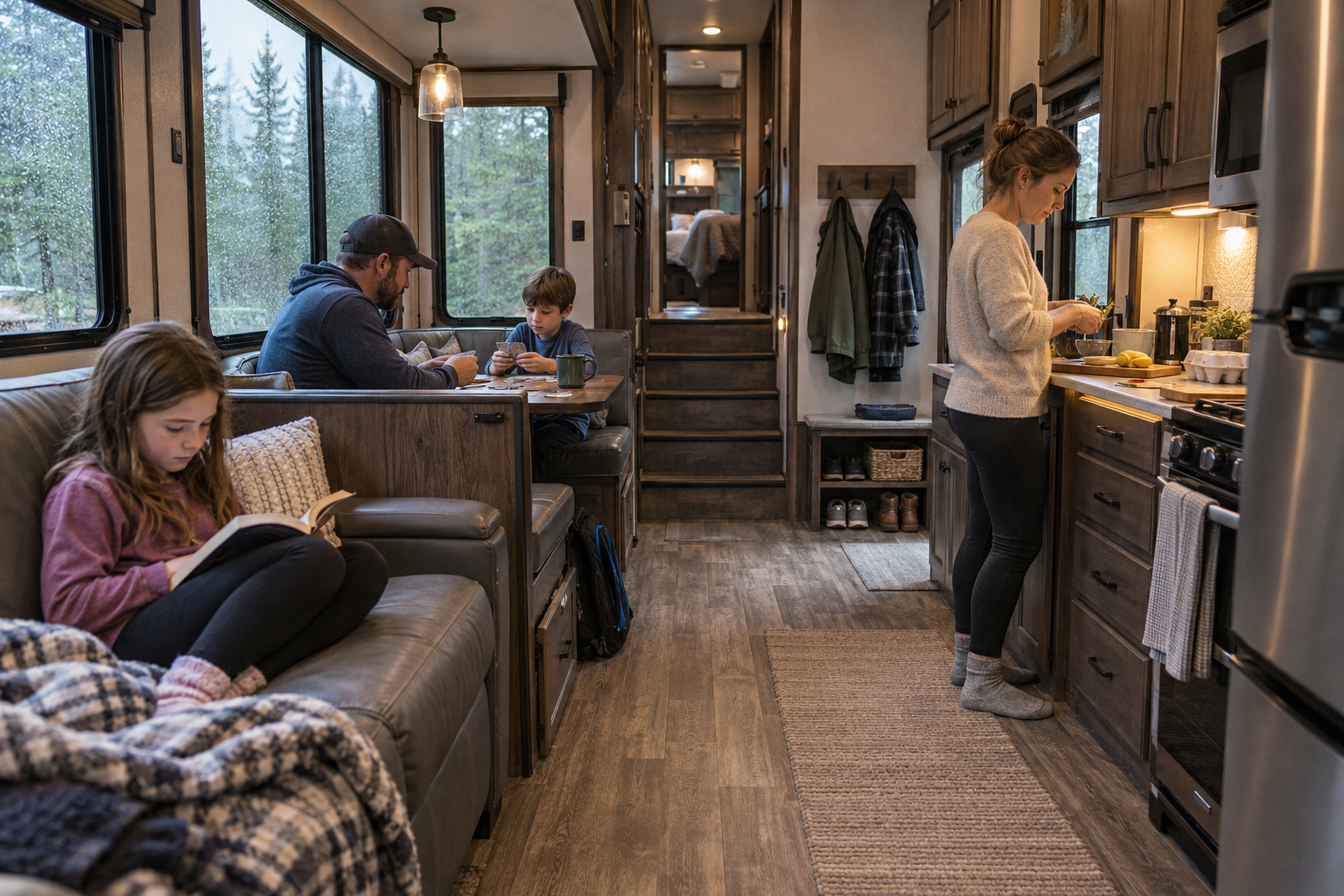
Picture a rainy afternoon with your usual group. That can tell you more than an empty showroom walkthrough.
3. Pay attention to steps and access
The raised section of a fifth wheel commonly means interior stairs. Depending on the floorplan, you may use those steps frequently to reach the bedroom or bathroom.
Many travel trailers keep their main living areas on one level, although entrance steps and interior details vary.
Try the steps yourself. Think about carrying a child, getting up during the night, or helping an older pet.
Also ask to see the RV with its slide-outs closed.
Can you reach the bathroom during a travel stop? Can you get lunch from the refrigerator? Can you load clothing into the bedroom before leaving home?
These answers are specific to the floorplan. Put them on your walkthrough checklist.

4. Understand the towing tradeoffs
You may hear that a fifth wheel is “easier to tow.”
Its hitch location creates different towing characteristics from a conventional travel trailer, and many drivers appreciate that feel. But maneuvering, backing, and clearance still require practice.
A travel trailer has its own handling characteristics and may require a weight-distribution hitch, sway-control equipment, or both, according to the manufacturers’ instructions. Lippert’s hitch and towing comparison.
For a fifth wheel, check the relationship between the truck bed, cab, hitch, and trailer. Bed length and hitch design affect turning clearance; don’t assume a particular truck and trailer will clear each other.
Both configurations require checking actual loaded weights, applicable ratings, brakes, tires, and equipment compatibility. Ford’s RV and Trailer Towing Guide.
Ask for an explanation of your specific setup and arrange time to practice before your first trip.

5. Think about what goes in the truck bed
Where do you plan to carry bicycles, tools, outdoor equipment, or a large cooler?
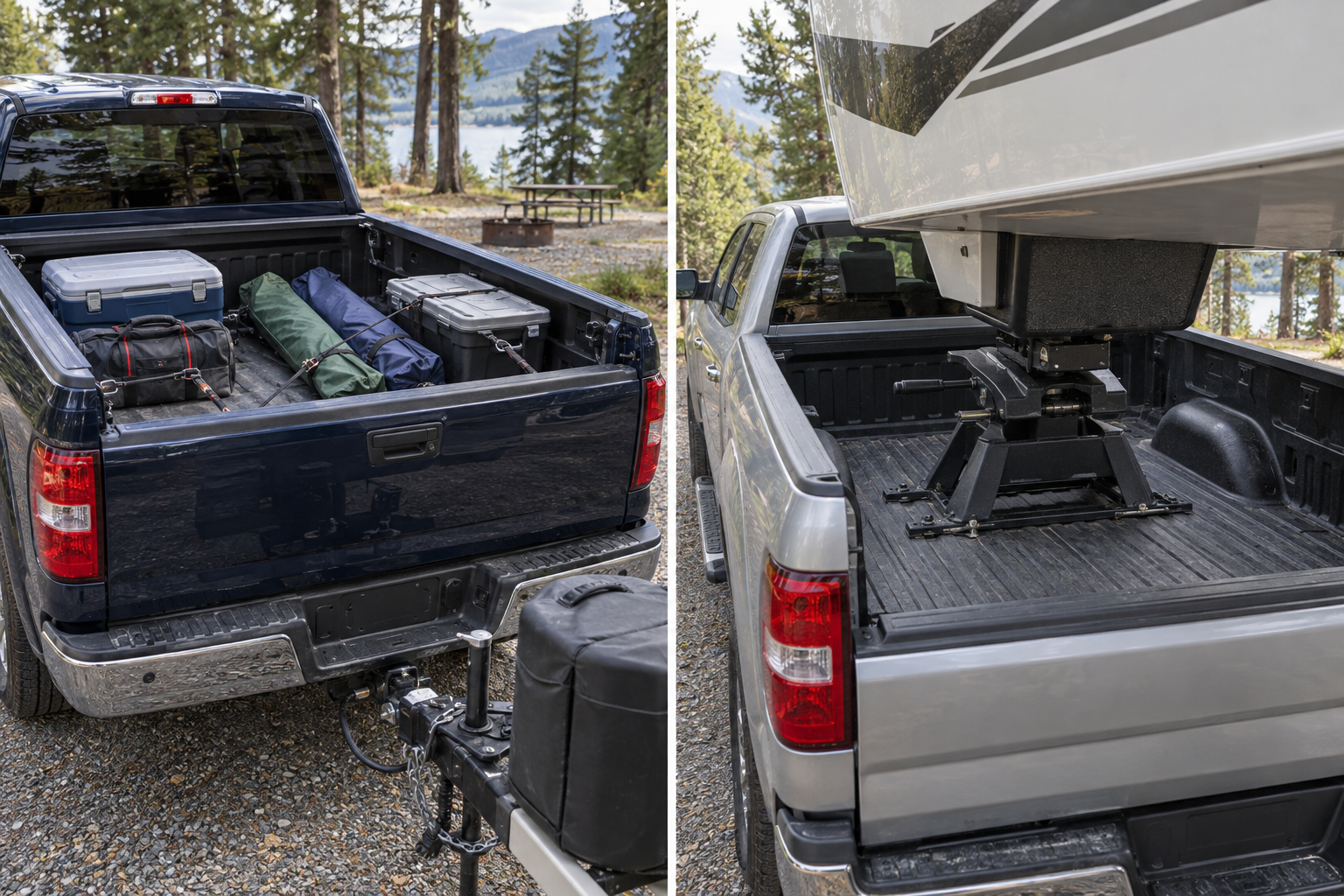
With a travel trailer, the hitch connection leaves the pickup bed available for cargo, subject to weight limits and clearance needs.
A fifth-wheel hitch occupies bed space. Other items must also stay clear of the trailer and hitch throughout turns and uneven terrain.
Some belongings may fit in the fifth wheel’s storage compartments instead. Before assuming that solves the problem, check both the dimensions and carrying capacity.
A large compartment tells you how much space is available. It doesn’t establish how much weight you can add.
Make a packing list before choosing your storage layout.
6. Match the RV to your destinations
Consider where you actually want to camp.
Do you prefer developed RV parks? Wooded public campgrounds? A familiar seasonal site? A different destination every few nights?
For each RV on your shortlist, investigate:
- Overall height and travel length
- Campsite dimensions and access
- Room for slide-outs and awnings
- Parking for the tow vehicle
- Your driveway and storage arrangement
A shorter travel trailer may suit the sites you prefer. A fifth wheel may offer living space you’ll appreciate during longer stays.
Neither category guarantees access. A large travel trailer can also be difficult to accommodate, and a shorter fifth wheel still needs adequate height and maneuvering clearance.
Check individual sites rather than assuming an entire campground will fit your setup.

7. Compare the complete cost
Travel trailers often provide a lower purchase-price starting point. Fifth wheels frequently cost more, although size, construction, equipment, and condition create plenty of overlap. Go RVing’s travel-trailer buying overview.
The more useful comparison is the total cost of the setup you need.
Include the RV, any tow-vehicle change, hitch equipment, taxes, registration, insurance, storage, and initial supplies. Then estimate maintenance, fuel, and campground expenses.
A trailer that works with a suitable vehicle you already own may lead to a very different budget from a fifth wheel that requires buying another truck.
Ask yourself:
“After buying this combination, will we still feel comfortable paying for the trips we want to take?”

8. Look at setup as a routine
Both types involve hitching, leveling, connecting utilities, and preparing the RV for use. Available equipment differs by model.
Automatic leveling, powered jacks, and other conveniences can make parts of that routine easier. Check what is actually included rather than assuming it comes with the category.
Ask someone to demonstrate the process from arrival to being ready to relax.
Then consider the departure routine, too.
If you mainly take short weekend trips, how does that amount of preparation fit your schedule? If you stay for several weeks, which conveniences would matter most once you’re settled?

A travel trailer may be a good starting point if…
- You want to explore smaller RVs as well as family-sized layouts.
- You hope to keep an existing, suitable tow vehicle.
- You value having the pickup bed available for equipment.
- You prefer a layout with fewer interior level changes.
- You want to begin with a lower overall purchase budget.
These are reasons to explore the category, not guarantees that every travel trailer will meet your needs.

A fifth wheel may be a good starting point if…
- You own or plan to buy a suitable pickup.
- You value tall ceilings and distinct living areas.
- You want to explore layouts with substantial exterior storage.
- You expect to spend enough time inside to appreciate the additional space.
- You’re comfortable with the steps, dimensions, and ownership costs of the models you’re considering.
A fifth wheel can work for weekend trips, and a travel trailer can work for extended travel. Your preferences and the specific RV matter more than a label.

Before you decide, tour one of each
Choose a travel trailer and a fifth wheel that are both realistic for your vehicle plans and budget.
Bring the same checklist to each. Sit on the furniture. Walk through bedtime and breakfast. Open the storage compartments. Ask about travel access with the slides closed.
Separate the requirements from the preferences.
Vehicle compatibility, suitable access, and a comfortable budget need to work before you start ranking favorite kitchens and bedrooms.
You may discover that the fifth wheel’s extra space is worth the additional commitment. You may find that a travel trailer gives you everything you need in a setup you’re more comfortable using.
Either can be a good decision when it fits your life.
Get the free First-Time RV Buyer’s Guide
Comparing travel trailers and fifth wheels is a starting point. The First-Time RV Buyer’s Guide helps you turn your preferences into a practical plan for evaluating individual RVs.
Inside, you’ll find explanations of RV types, worksheets for your travel plans and budget, a walkthrough scorecard, and questions to help you prepare for delivery. There are also first-time buyer FAQs and a plain-English glossary.
Use the form below to request your free digital copy. Keep it with you as you compare layouts, review vehicle compatibility, tour RVs, and build your shortlist.
Want to talk through your options?
I’m Si, founder of RV Boat Guide and an RV & Boat Outfitter. I help RV and boat buyers throughout the Pacific Northwest and can also help connect buyers elsewhere with a trusted outfitter in their area.
If you’re weighing a travel trailer against a fifth wheel or wondering whether your current vehicle fits your plans; I’d welcome the opportunity to help.
Message me using the form below. Tell me who will be traveling with you, how you hope to use your RV, and what vehicle you currently drive or plan to buy.
You don’t need to have a category or model picked out to start the conversation.